Skip to content
Catecharium

Gallery I, The Messiah · Room 1

The Coming

Centuries before Jesus was born, the prophets of Israel said which family He would come from, who His mother would be, where He would be born, and who would announce Him.

The Old Testament is the part of the Bible written before Christ. Running through it is a promise that God would send a king and saviour, whom the Jewish people came to call the Messiah. The promise was made in stages, by different prophets over more than a thousand years, and each stage was more specific than the last.

This room has eight stops. At each one you will read a prophecy from the Old Testament, then the passage in the New Testament that records it coming true, and then a note on the two. A display case at the end holds the oldest surviving copy of one of the books quoted here.

1 of 8

The First Promise

Genesis, the first book of the Bible, begins with God making the first man and woman and placing them in a garden. A serpent, whom later Scripture identifies as the devil, persuades them to disobey God. This is the first sin, and death enters the world with it.

God then speaks to each of the three in turn, beginning with the serpent. In this older English, “enmities” means lasting hostility and “seed” means offspring.

The prophecy

God, to the serpent, in the garden of Eden, at the beginning of human history

I will put enmities between thee and the woman, and thy seed and her seed: she shall crush thy head, and thou shalt lie in wait for her heel.

Genesis 3:15

The Old Testament closes without saying who this child is. Saint Paul, writing to the Christians of Galatia about twenty years after the death of Jesus, describes His coming in words that recall the promise.

The fulfilment

Galatians 4:4

But when the fulness of the time was come, God sent his Son, made of a woman, made under the law:

Douay-Rheims, Challoner revision

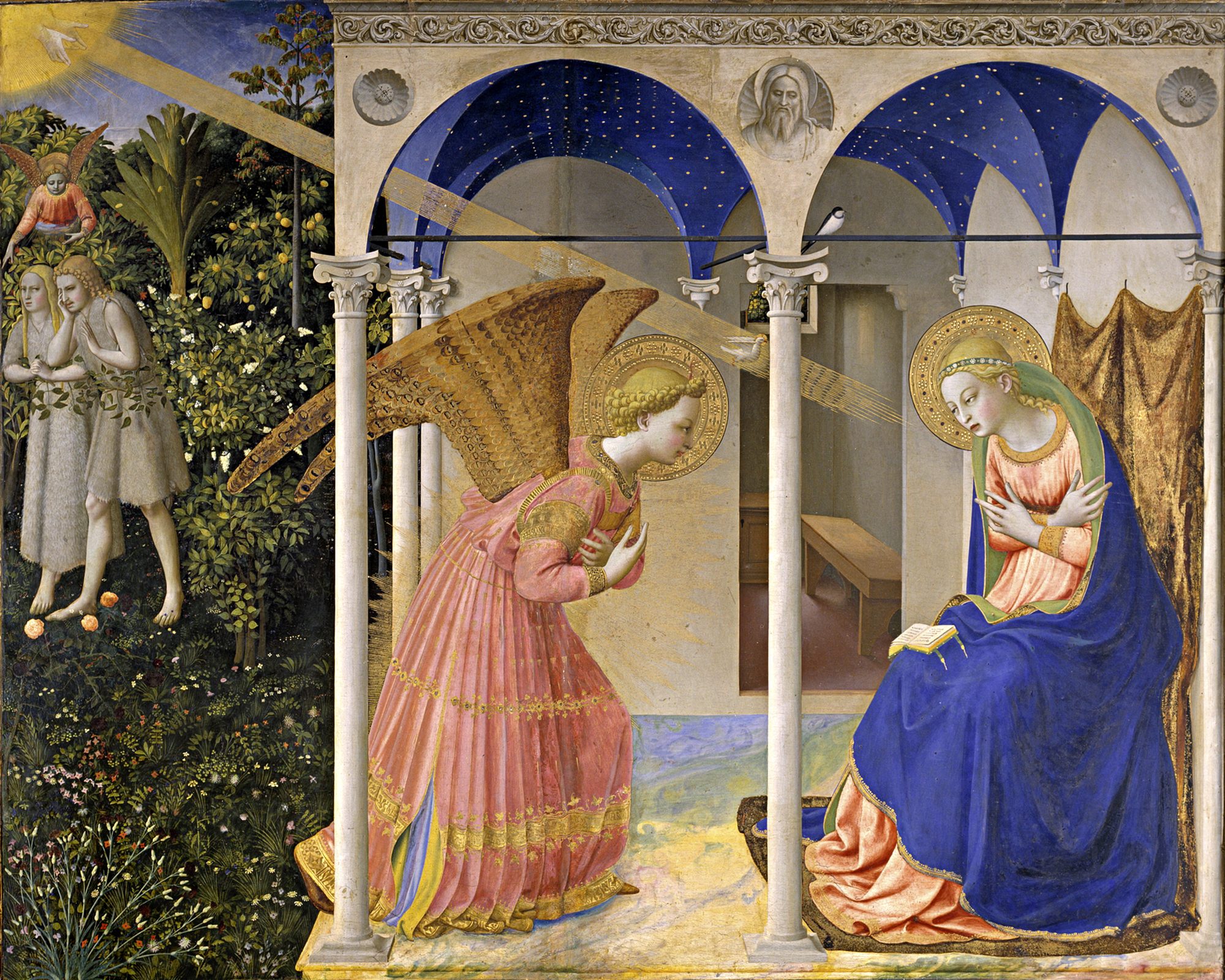
Under a loggia the angel Gabriel bows to the Virgin Mary, and a ray of gold light falls on her from the upper left. In the garden behind the angel, Adam and Eve are driven out of Paradise.
Fra AngelicoThe Annunciation, about 1426Museo Nacional del Prado, Madrid

Fra Angelico put both ends of the promise in one painting. In the foreground the angel Gabriel tells Mary she will bear a son. In the garden at the left, Adam and Eve are being sent out of Eden.

2 of 8

The Promise Narrows

The first promise said only that the child would be born of a woman. It did not say when, or into which people or family. Over the next thousand years and more, a series of later promises answered those questions.

The five passages below are arranged by family tree, from the widest group to the narrowest, so the fourth is later in date than the fifth. “Seed” again means offspring, and “Juda” is this translation’s spelling of Judah.

The prophecies

Five promises, from the widest to the narrowest

  1. A child of the woman

    God, in the garden, In the beginning

    Genesis 3:15

    I will put enmities between thee and the woman, and thy seed and her seed

    The promise as it was first given: the child will be a human being.

  2. A descendant of Abraham

    God, to Abraham, about 1900 BC

    Genesis 22:18

    And in thy seed shall all the nations of the earth be blessed

    Abraham is the ancestor of the people of Israel. The child will come from his family, and every other nation will be blessed through Him.

  3. From the tribe of Judah

    Jacob, on his deathbed, to his sons, about 1700 BC

    Genesis 49:10

    The sceptre shall not be taken away from Juda, nor a ruler from his thigh, till he come that is to be sent, and he shall be the expectation of nations.

    Jacob was Abraham’s grandson, and his twelve sons founded the twelve tribes of Israel. A sceptre is a king’s staff. Jacob says that kingship belongs to the tribe of his son Judah, and that someone is still to be sent.

  4. From the family of Jesse

    Isaiah, about 730 BC

    Isaiah 11:1

    And there shall come forth a rod out of the root of Jesse, and a flower shall rise up out of his root.

    Jesse belonged to the tribe of Judah and lived in Bethlehem. Isaiah describes his family as a tree cut back to the root, from which a new shoot will grow.

  5. From the royal line of David

    The prophet Nathan, to King David, about 1000 BC

    2 Samuel 7:12, 16

    12And when thy days shall be fulfilled, and thou shalt sleep with thy fathers, I will raise up thy seed after thee, which shall proceed out of the bowels, and I will establish his kingdom.

    16And thy house shall be faithful, and thy kingdom for ever before thy face, and thy throne shall be firm for ever.

    David was Jesse’s youngest son and became the greatest of Israel’s kings. Through Nathan, God promises him a descendant whose kingdom will last for ever.

The New Testament opens with the Gospel of Matthew, one of the four accounts of the life of Jesus, and its first sentence names two of these ancestors. The second passage is from the Gospel of Luke, where the angel Gabriel tells Mary who her son will be.

The fulfilment

Matthew 1:1

The book of the generation of Jesus Christ, the son of David, the son of Abraham:

Luke 1:32-33

32He shall be great and shall be called the Son of the Most High. And the Lord God shall give unto him the throne of David his father: and he shall reign in the house of Jacob for ever.

33And of his kingdom there shall be no end.

Douay-Rheims, Challoner revision

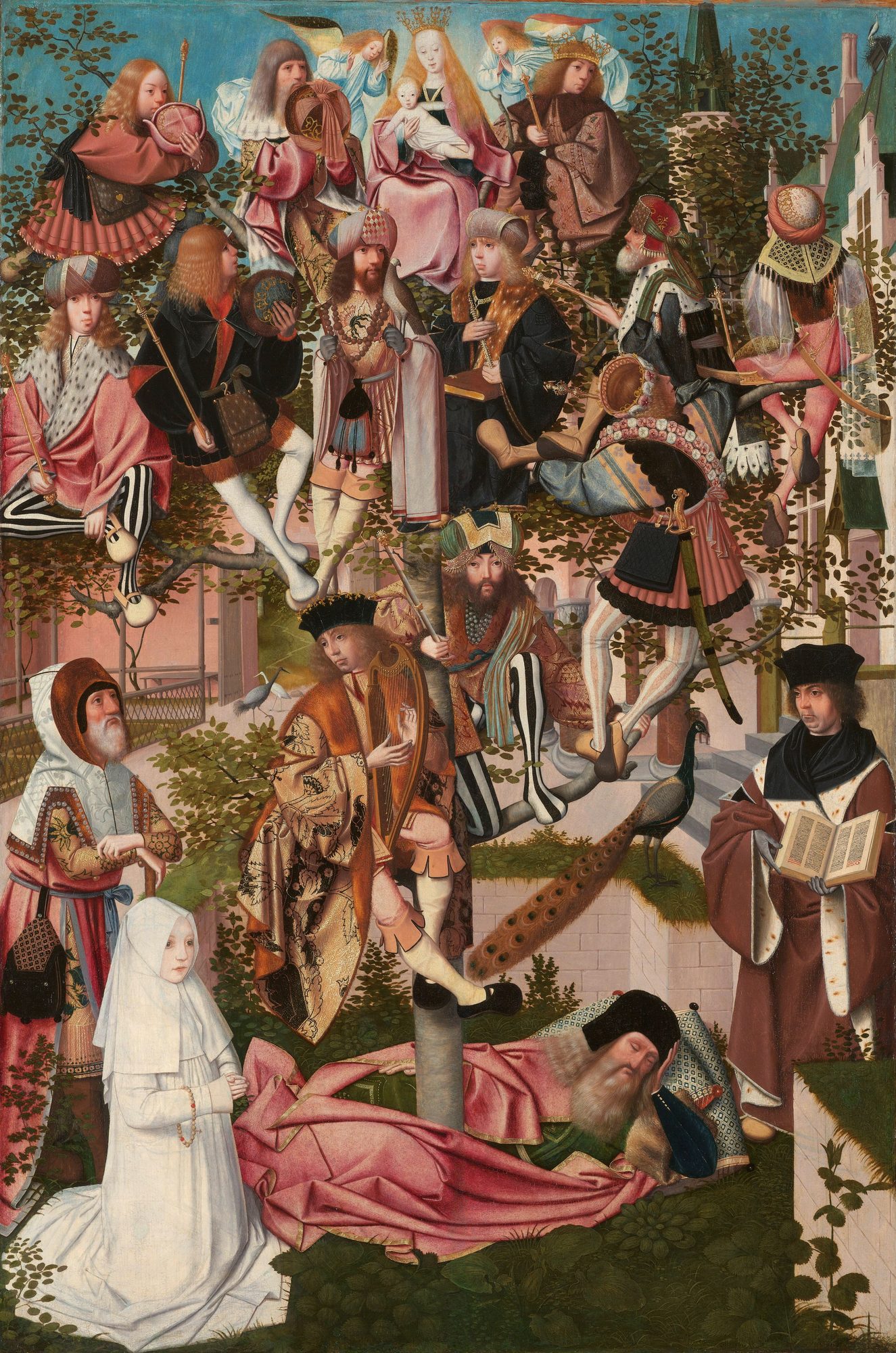
Jesse lies asleep on the ground and a tree grows from his body. The kings of Judah sit among its branches in rich clothes, David with his harp among them, and at the top the Virgin holds the Child.
Attributed to Geertgen tot Sint JansThe Tree of Jesse, about 1500Rijksmuseum, Amsterdam

The family tree painted literally. Jesse lies asleep at the bottom and the tree grows from his body. The kings descended from him sit in its branches, David among them with a harp, and Mary holds the child Jesus at the top.

3 of 8

The Sign

About 735 BC two neighbouring kingdoms joined forces against Jerusalem, and its king, Ahaz, expected to lose his throne. The prophet Isaiah brought him a message from God that the attack would fail, and told him to ask for any sign he liked as proof. Ahaz declined to ask. Isaiah answered that God would give a sign of His own choosing.

The prophecy

Isaiah, to King Ahaz, in Jerusalem, about 735 BC

Therefore the Lord himself shall give you a sign. Behold a virgin shall conceive, and bear a son and his name shall be called Emmanuel.

Isaiah 7:14

Seven centuries later Matthew and Luke each describe how Jesus was conceived. Matthew quotes Isaiah’s sentence. Luke gives the conversation between the angel Gabriel and Mary.

The fulfilment

Seven centuries later

Matthew 1:22-23

22Now all this was done that it might be fulfilled which the Lord spoke by the prophet, saying:

23Behold a virgin shall be with child, and bring forth a son, and they shall call his name Emmanuel, which being interpreted is, God with us.

Luke 1:27, 31, 34-35

27To a virgin espoused to a man whose name was Joseph, of the house of David: and the virgin's name was Mary.

31Behold thou shalt conceive in thy womb and shalt bring forth a son: and thou shalt call his name Jesus.

34And Mary said to the angel: How shall this be done, because I know not man?

35And the angel answering, said to her: The Holy Ghost shall come upon thee and the power of the Most High shall overshadow thee. And therefore also the Holy which shall be born of thee shall be called the Son of God.

Douay-Rheims, Challoner revision

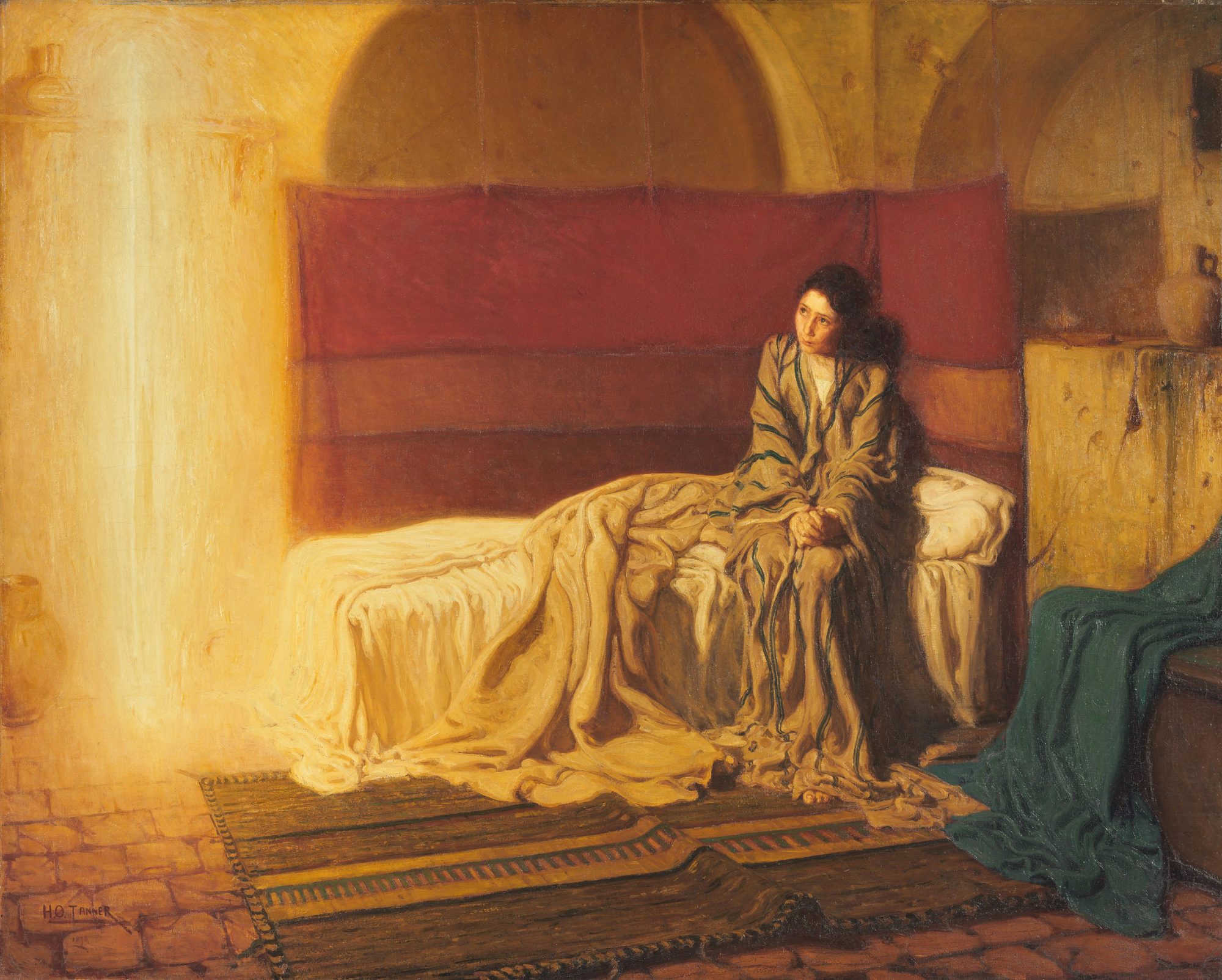
A young woman in plain robes sits on the edge of a rumpled bed in a bare stone room, hands folded, looking up at a tall column of golden light that stands where the angel would be.
Henry Ossawa TannerThe Annunciation, 1898Philadelphia Museum of Art

Henry Ossawa Tanner painted the scene Luke describes. Mary sits on the edge of her bed in a plain room, and the angel appears as a column of light.

The same verse in three older languages

The argument turns on a single word. Isaiah wrote in Hebrew. About two hundred years before Jesus was born, Jewish scholars in Egypt translated the Hebrew Scriptures into Greek, in a version called the Septuagint. Around AD 400 Saint Jerome translated them into Latin, and his version, the Vulgate, was the Bible of the Western Church for more than a thousand years. The word for the mother is marked in each.

Hebrew

לָ֠כֵן יִתֵּ֨ן אֲדֹנָ֥י ה֛וּא לָכֶ֖ם א֑וֹת הִנֵּ֣ה הָעַלְמָ֗ה הָרָה֙ וְיֹלֶ֣דֶת בֵּ֔ן וְקָרָ֥את שְׁמ֖וֹ עִמָּ֥נוּ אֵֽל׃

ha-almah

The Masoretic text, Westminster Leningrad Codex

Greek

διὰ τοῦτο δώσει Κύριος αὐτὸς ὑμῖν σημεῖον· ἰδοὺ ἡ παρθένος ἐν γαστρὶ λήμψεται καὶ τέξεται υἱόν, καὶ καλέσεις τὸ ὄνομα αὐτοῦ Ἐμμανουήλ·

he parthenos

The Septuagint, translated by Jewish scholars before the birth of Christ

Latin

Propter hoc dabit Dominus ipse vobis signum: ecce virgo concipiet, et pariet filium, et vocabitur nomen ejus Emmanuel.

The Vulgate of Saint Jerome

The Greek is the important one. Its translators were Jews working long before there were any Christians, and the word they chose, parthenos, is the ordinary Greek word for a virgin. Matthew, who wrote in Greek, quotes the verse in their translation.

4 of 8

The Place

Micah lived at the same time as Isaiah and came from a farming village in Judah, the southern of the two Israelite kingdoms. In this passage he addresses a town directly. Bethlehem lies about six miles south of Jerusalem. It was a small place, and its one claim to notice was that King David had been born there. Ephrata is an older name for the district.

The prophecy

The prophet Micah, about 730 BC

Micah 5:2

And thou Bethlehem Ephrata, art a little one among the thousands of Juda, out of thee shall he come forth unto me that is to be the ruler in Israel: and his going forth is from the beginning, from the days of eternity.

Matthew and Luke both record where Jesus was born. In Matthew, King Herod asks his scholars where the Messiah is expected, and they answer by quoting Micah. Luke explains how a couple from Nazareth came to be in Bethlehem at all.

The fulfilment

Seven centuries later

Matthew 2:1, 5-6

1When Jesus therefore was born in Bethlehem of Juda, in the days of king Herod, behold, there came wise men from the East to Jerusalem,

5But they said to him: In Bethlehem of Juda. For so it is written by the prophet:

6And thou Bethlehem the land of Juda art not the least among the princes of Juda: for out of thee shall come forth the captain that shall rule my people Israel.

Luke 2:4, 6-7

4And Joseph also went up from Galilee, out of the city of Nazareth, into Judea, to the city of David, which is called Bethlehem: because he was of the house and family of David.

6And it came to pass that when they were there, her days were accomplished that she should be delivered.

7And she brought forth her first born son and wrapped him up in swaddling clothes and laid him in a manger: because there was no room for them in the inn.

Douay-Rheims, Challoner revision

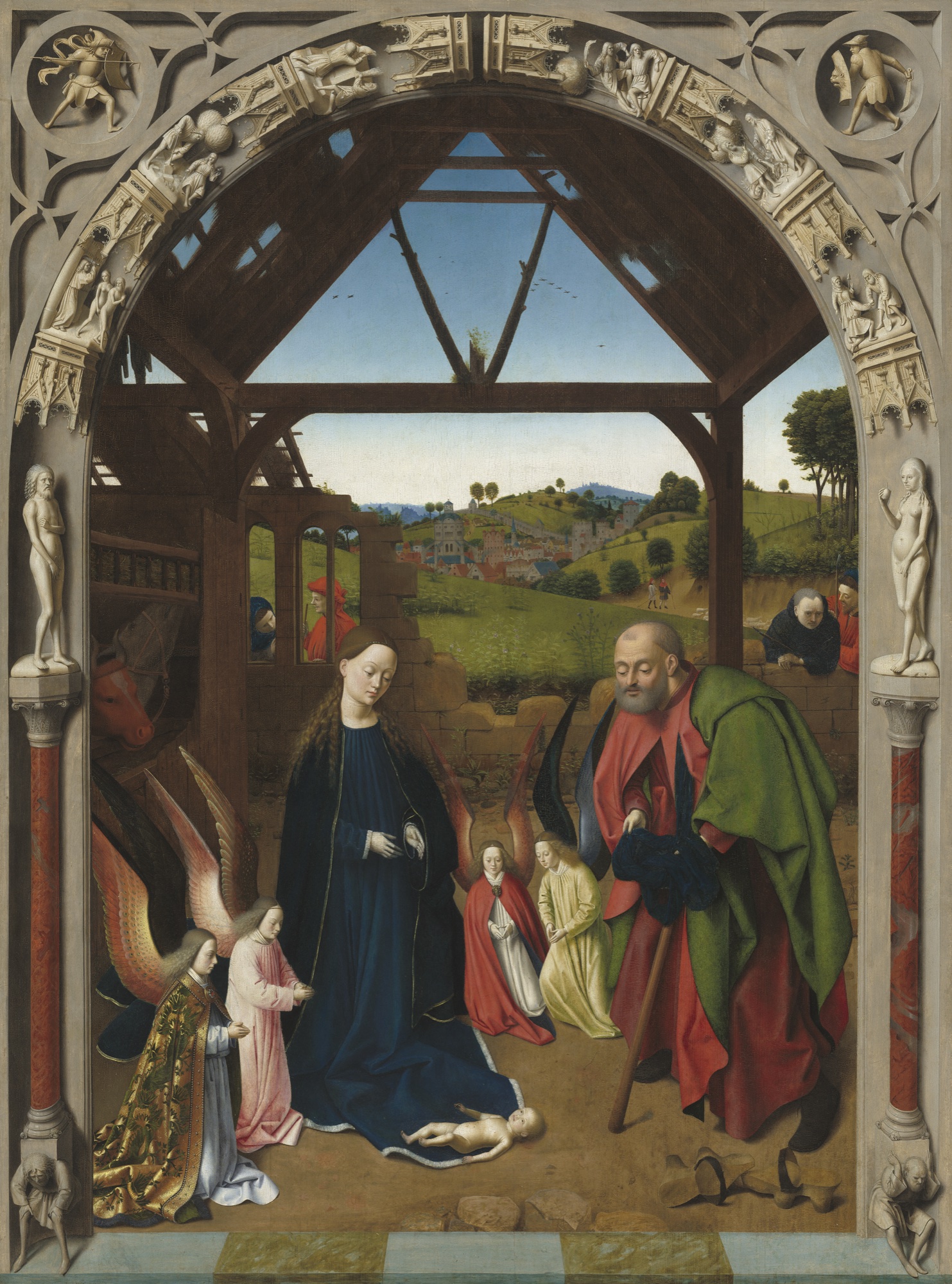
Seen through a carved stone arch, Mary and Joseph kneel in a ruined stable with four small angels, looking down at the newborn Child lying on the ground. Through the open back of the stable a town climbs a green hill. Small statues of Adam and Eve stand on the pillars of the arch.
Petrus ChristusThe Nativity, about 1450National Gallery of Art, Washington

Mary and Joseph kneel beside the newborn child in a broken-down stable, and the town of Bethlehem stands on the hill behind them. The statues on the pillars of the arch are Adam and Eve, to whom the first promise was made.

5 of 8

The Names

Isaiah spoke these words when the Assyrian empire had overrun the northern part of the country and was expected to take the rest. To people in that position he announces the birth of a child who will rule, and he lists the titles the child will bear.

The prophecy

The prophet Isaiah, about 730 BC

Isaiah 9:6

For a CHILD IS BORN to us, and a son is given to us, and the government is upon his shoulder: and his name shall be called Wonderful, Counsellor, God the Mighty, the Father of the world to come, the Prince of Peace.
  • Wonderful
  • Counsellor
  • God the Mighty
  • the Father of the world to come
  • the Prince of Peace

Luke records that on the night Jesus was born, an angel appeared to shepherds in the fields outside Bethlehem and told them what had happened.

The fulfilment

Seven centuries later

Luke 2:10-11

10And the angel said to them: Fear not; for, behold, I bring you good tidings of great joy that shall be to all the people:

11For, this day is born to you a Saviour, who is Christ the Lord, in the city of David.

Douay-Rheims, Challoner revision

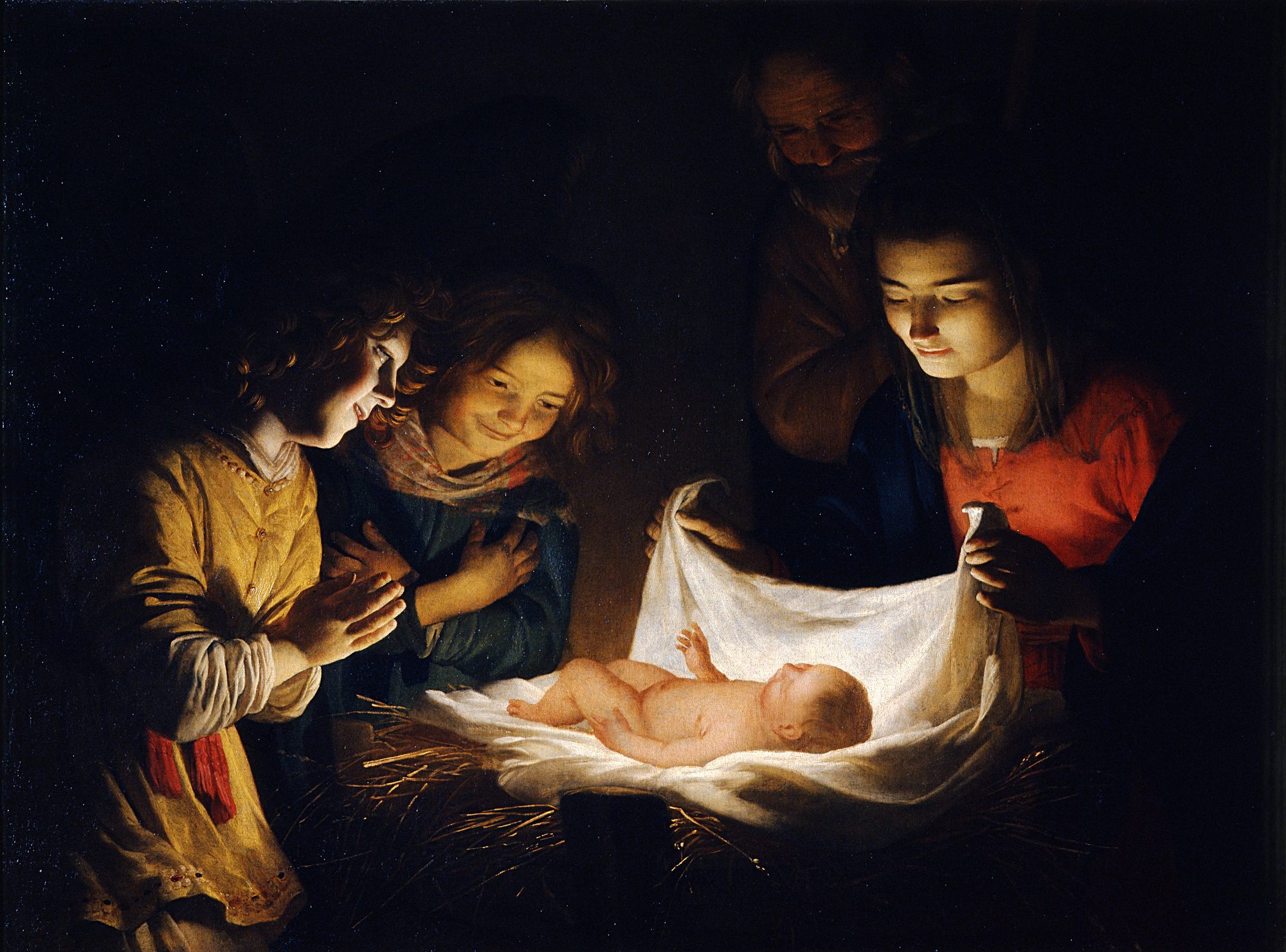
In deep darkness Mary draws back a white cloth from the newborn Child, and the light that fills the picture comes from Him. Two young angels and Joseph lean in, their faces lit from below.
Gerard van HonthorstAdoration of the Child, 1619 to 1620Galleria degli Uffizi, Florence

Honthorst painted the scene with no lamp or fire in it. The light on the faces comes from the child.

6 of 8

The Star

This prophecy was given by a man who was not an Israelite. About 1400 BC the people of Israel, nearing the end of their journey from Egypt, were camped on the border of Moab, east of the river Jordan. The king of Moab was afraid of them and hired Balaam, a seer from Mesopotamia, to pronounce a curse on them. The Book of Numbers says that each time Balaam tried, God gave him a blessing to speak instead. These lines come from the last of them.

“Jacob” here is another name for the people of Israel, who were descended from him.

The prophecy

Balaam, a foreign seer, about 1400 BC

Numbers 24:17

I shall see him, but not now: I shall behold him, but not near. A STAR SHALL RISE out of Jacob and a sceptre shall spring up from Israel

Matthew records that after Jesus was born, visitors from the East arrived in Jerusalem looking for a newborn king. He calls them wise men. They were probably astrologers from Persia or Babylonia.

The fulfilment

Fourteen centuries later

Matthew 2:1-2

1When Jesus therefore was born in Bethlehem of Juda, in the days of king Herod, behold, there came wise men from the East to Jerusalem,

2Saying: Where is he that is born king of the Jews? For we have seen his star in the East, and are come to adore him.

Douay-Rheims, Challoner revision

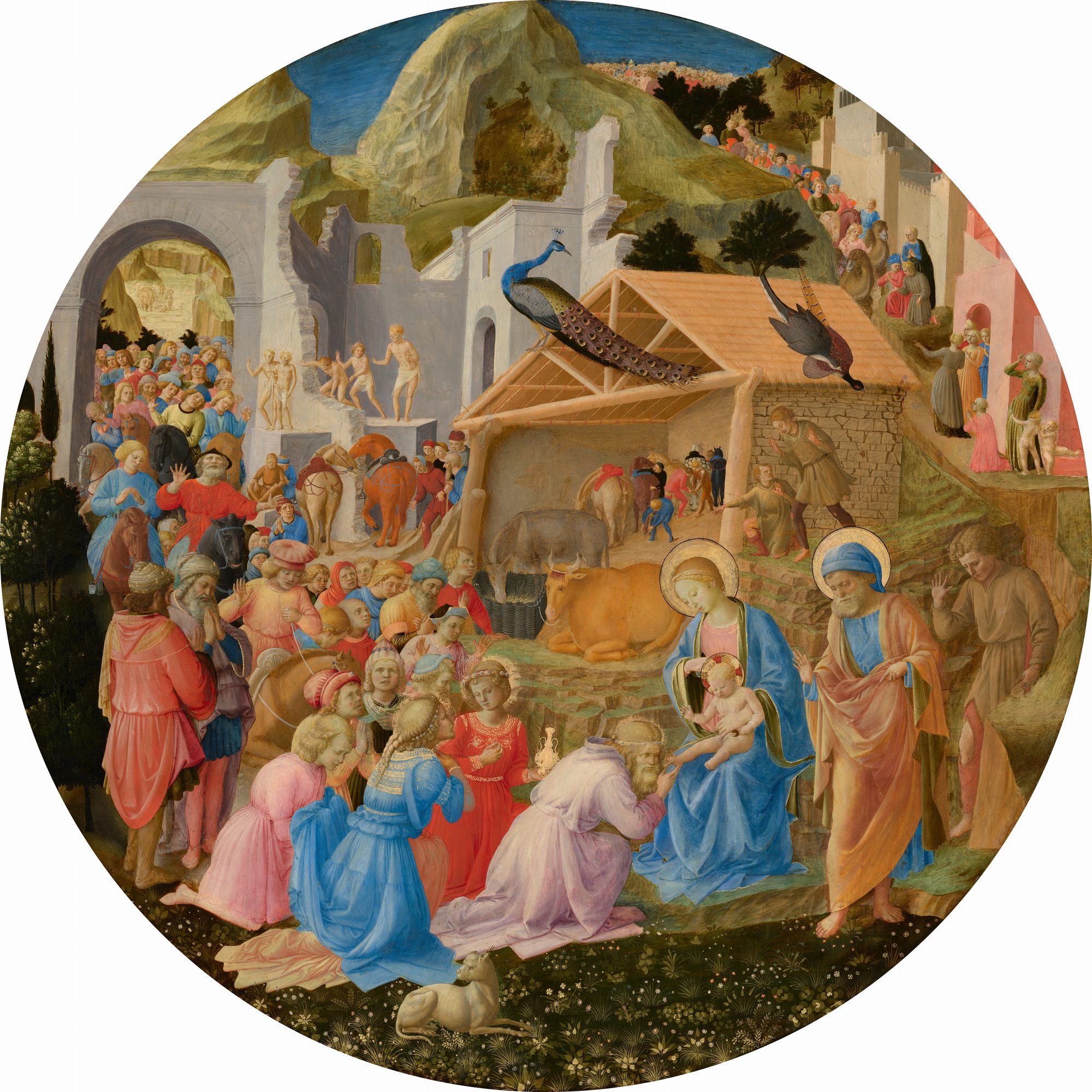
A round painting. A long procession winds down from a hill city and through a ruined arch to the stable, where the three wise men kneel before the Virgin and Child.
Fra Angelico and Fra Filippo LippiThe Adoration of the Magi, about 1440 to 1460National Gallery of Art, Washington

The wise men kneel before Mary and the child at the stable, and the long procession that travelled with them winds down the hill behind.

7 of 8

The Shadow

When the wise men asked in Jerusalem for a newborn king, Herod took the child for a rival and set out to kill Him. Matthew tells what followed in two episodes, and in each he quotes a prophet.

The prophecy

Hosea, about 750 BC

Hosea is looking back to the Exodus, centuries before his time, when God brought the people of Israel out of slavery in Egypt. God speaks of that people as His son.

Hosea 11:1

Because Israel was a child, and I loved him: and I called my son out of Egypt.

The fulfilment

Matthew: an angel warns Joseph in a dream, and he takes Mary and the child to Egypt, where they stay until Herod is dead.

Matthew 2:14-15

14Who arose, and took the child and his mother by night, and retired into Egypt: and he was there until the death of Herod:

15That it might be fulfilled which the Lord spoke by the prophet, saying: Out of Egypt have I called my son.
The prophecy

Jeremiah, about 600 BC

Rachel was the wife of Jacob and one of the mothers of the Israelite people. Her tomb was near Bethlehem. Jeremiah, writing as his people were led away as captives, imagines her mourning for them.

Jeremiah 31:15

Thus saith the Lord: A voice was heard on high of lamentation, of mourning, and weeping, of Rachel weeping for her children and refusing to be comforted for them, because they are not.

The fulfilment

Matthew: Herod, unable to find the child, has every boy in and around Bethlehem aged two or under put to death.

Matthew 2:16-18

16Then Herod perceiving that he was deluded by the wise men, was exceeding angry: and sending killed all the menchildren that were in Bethlehem, and in all the borders thereof, from two years old and under, according to the time which he had diligently inquired of the wise men.

17Then was fulfilled that which was spoken by Jeremias the prophet, saying:

18A voice in Rama was heard, lamentation and great mourning; Rachel bewailing her children, and would not be comforted, because they are not.

Douay-Rheims, Challoner revision

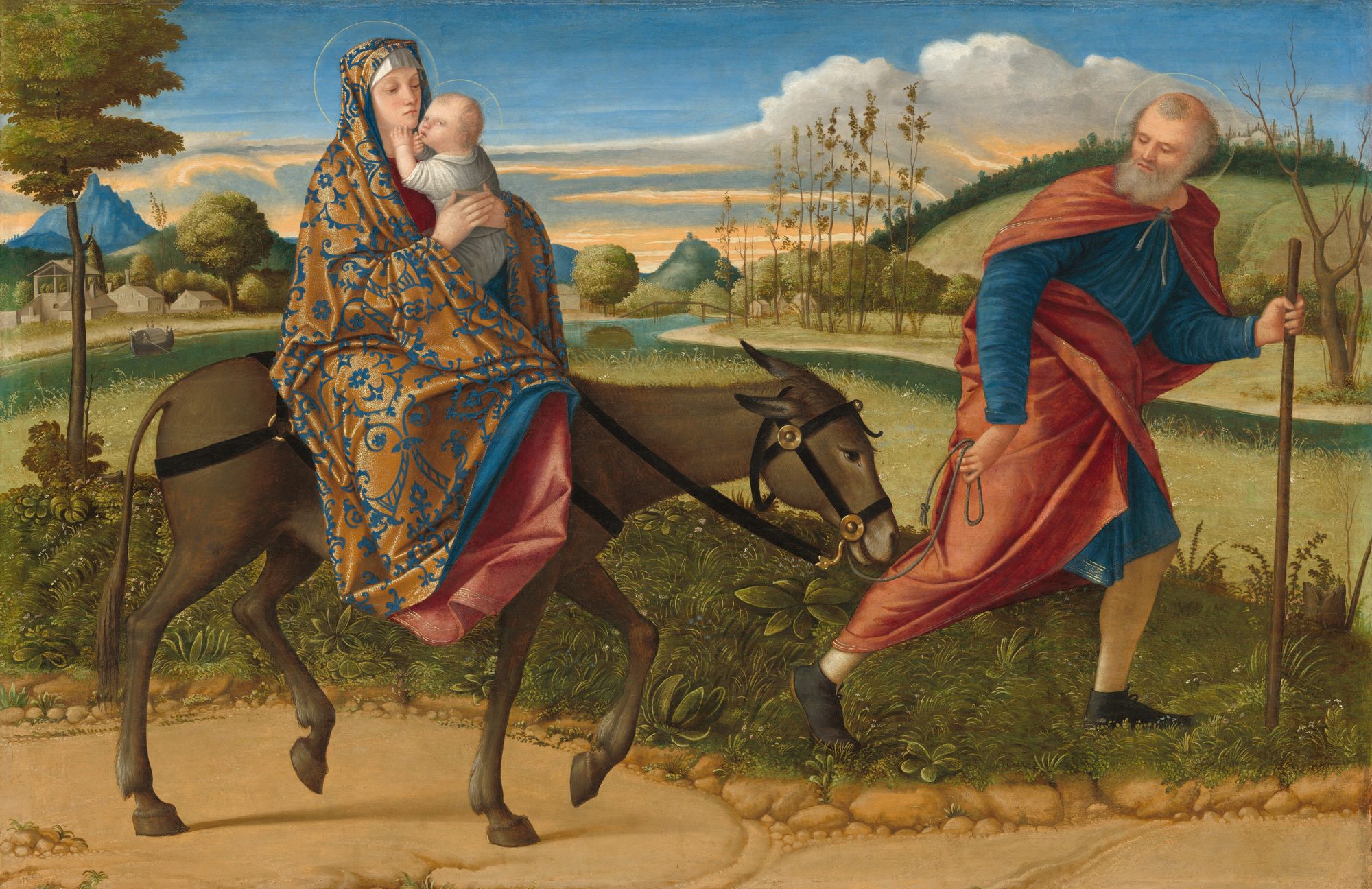
Joseph strides ahead with a staff, leading a donkey on which Mary rides holding the Child close against her face. A quiet river landscape lies behind them.
Vittore CarpaccioThe Flight into Egypt, about 1515National Gallery of Art, Washington

Joseph walks ahead leading the donkey, and Mary holds the child against her face. They are on the road to Egypt.

8 of 8

The Voice

In the ancient world a herald went ahead of a king to announce his arrival and have the road made ready. Two prophets said that the Messiah would be preceded in the same way. Isaiah describes a voice calling out in the desert. Malachi, the last of the Old Testament prophets, has God promise to send a messenger ahead of Him. This translation renders the word as “angel”, which in its original sense means a messenger.

The prophecies

Isaiah, about 700 BC

Isaiah 40:3

The voice of one crying in the desert: Prepare ye the way of the Lord, make straight in the wilderness the paths of our God.

Malachi, about 430 BC

Malachi 3:1

Behold I send my angel, and he shall prepare the way before my face.

No prophet is recorded in Israel for about four hundred years after Malachi. Luke’s Gospel then opens with a priest named Zachary and his wife Elizabeth, a relative of Mary, who have a son in their old age and name him John. The first passage is what Zachary says over the newborn child. The second is Matthew’s description of John as a grown man. “Isaias” is this translation’s spelling of Isaiah.

The fulfilment

Luke 1:76

And thou, child, shalt be called the prophet of the Highest: for thou shalt, go before the face of the Lord to prepare his ways:

Matthew 3:1, 3

1And in those days cometh John the Baptist preaching in the desert of Judea.

3For this is he that was spoken of by Isaias the prophet, saying: A voice of one crying in the desert, Prepare ye the way of the Lord, make straight his paths.

Douay-Rheims, Challoner revision

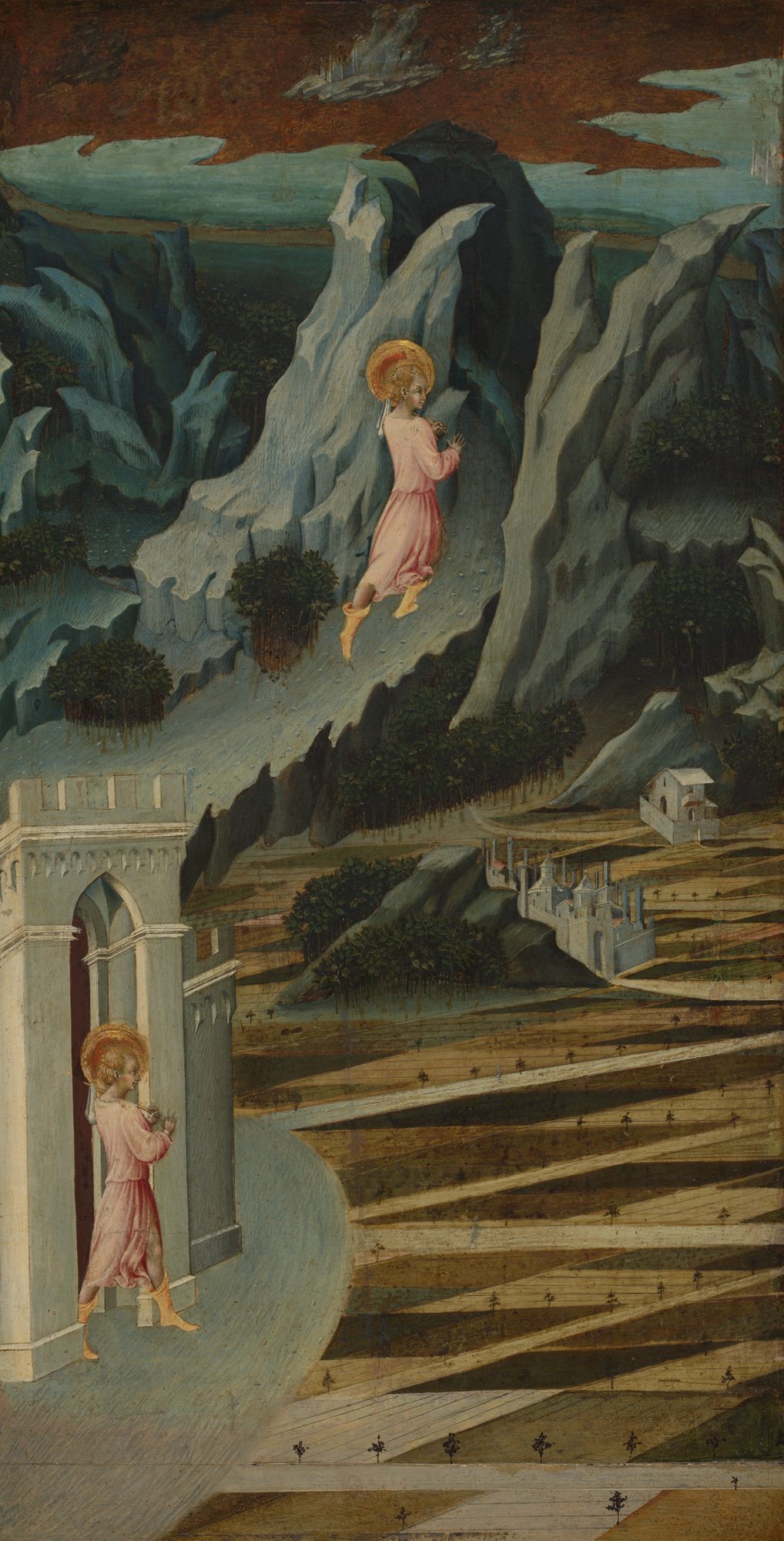
A tall, narrow panel. At the bottom a boy in a pink tunic walks out of a city gate. Higher up the same boy, now small, climbs a path into steep blue mountains above a patchwork of fields.
Giovanni di PaoloSaint John the Baptist Entering the Wilderness, 1455 to 1460The Art Institute of Chicago

Giovanni di Paolo shows John twice in one panel. At the bottom he leaves the city gate as a boy, and higher up, drawn smaller, he climbs into the mountains.

In the case

The Scroll

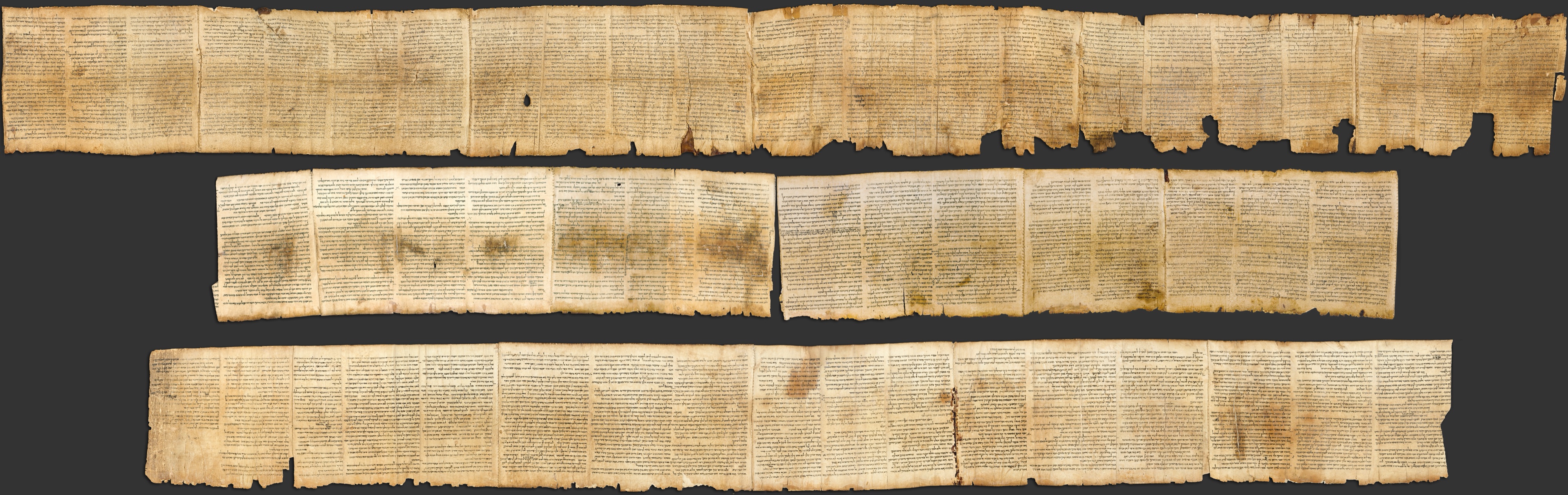
The whole Great Isaiah Scroll laid flat on a dark ground in three rows of joined parchment sheets, a long row across the top and two shorter rows below, every sheet covered in narrow columns of small Hebrew writing.
The Great Isaiah ScrollInk on parchment, copied about 125 BCFound in 1947 in a cave at Qumran, above the Dead SeaThe Shrine of the Book, Israel Museum, JerusalemPhotograph by Ardon Bar Hama, Israel Museum
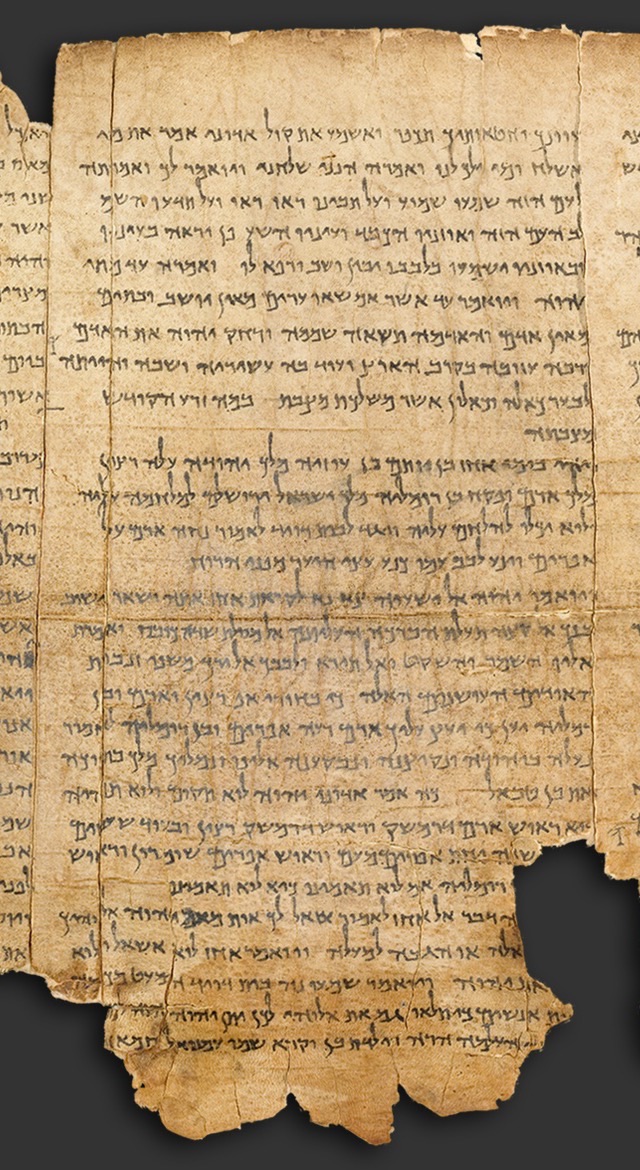
One column of the scroll close up: dense lines of black Hebrew script on tan parchment, a seam running across the sheet and a torn, ragged lower edge.
The column that holds Isaiah 7:14.Photograph by Ardon Bar Hama, Israel Museum
© 2026 Catecharium